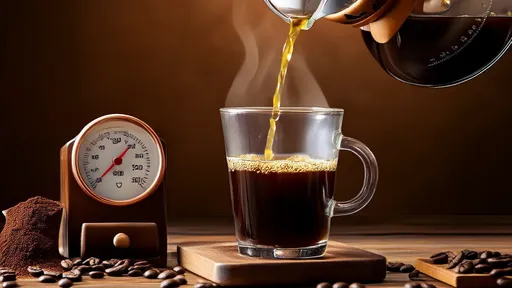
In the intricate world of specialty coffee, few variables command as much attention and debate as water temperature. It is the silent conductor of the extraction orchestra, a fundamental force that can either coax out a symphony of flavors or lead to a cacophonous brew. Among the myriad of temperatures discussed in brewing guides and cafe training manuals, 92°C (197.6°F) has emerged as a particularly revered benchmark for many pour-over aficionados and professional baristas. This is not an arbitrary number plucked from the air but a sweet spot, a thermal equilibrium where the complex chemistry within the coffee grounds interacts with water in a manner often described as achieving a remarkable balance.
The journey to this consensus is rooted in basic chemistry. Water is a superb solvent, and its ability to extract compounds from coffee grounds is heavily dependent on its thermal energy. Hotter water is more energetic; it moves faster and has a greater capacity to dissolve solids. However, this relationship is not linear, and the various flavor compounds in coffee dissolve at different rates and at different temperatures. The coveted soluble—the sugars, the acids, the lipids, and the aromatic compounds—each have their own preferred extraction window. Too cool, and the water lacks the vigor to pull out the deeper, sugary caramelizations and the full-bodied oils, resulting in a brew that is underwhelmingly sour, thin, and acidic. Too hot, and the extraction becomes aggressive and indiscriminate, scorching the grounds and seizing bitter, astringent tannins and undesirable compounds that overpower the delicate nuances, leading to a harsh, burnt taste.
This is where the magic of 92°C begins to reveal itself. For a wide spectrum of coffee beans, particularly those of a light to medium roast profile which dominate the specialty scene, this temperature acts as a perfect mediator. It provides ample energy to efficiently extract the pleasant fruity acids and the complex sugars developed during the roasting process without aggressively attacking the compounds that contribute excessive bitterness. The result is a cup that showcases clarity and definition. The bright, wine-like acidity of a Kenyan coffee or the floral top notes of an Ethiopian Yirgacheffe are preserved and highlighted, yet they are seamlessly woven into a tapestry of sweetness—notes of brown sugar, caramel, or stone fruit—with a clean finish devoid of the rough, drying bitterness that signifies over-extraction. It achieves what baristas tirelessly pursue: flavor balance.
Of course, presenting 92°C as a universal panacea would be an oversimplification of the art of brewing. It is a superb starting point, a foundational pillar, but it is not an immutable law. The ideal temperature is, in fact, a moving target, finely tuned by several key variables intrinsic to the coffee itself. The roast level is perhaps the most significant modifier. The chemical structure of a coffee bean undergoes dramatic changes during roasting. Dark roast beans are more porous and brittle; their cell structures have been broken down more thoroughly by the extended heat of the roast. Consequently, they extract much more easily. Using water at 92°C on a dark roast can very quickly lead to over-extraction and bitterness. For these beans, a lower temperature, perhaps between 85°C and 88°C, is often employed to gentle the extraction process and prevent the release of an overwhelming amount of bitter compounds.
Conversely, a very light roast, sometimes referred to as a "Nordic" roast, is incredibly dense. Its cellular structure remains largely intact, making it notoriously difficult to extract. For these stubborn beans, a barista might need to push the temperature even higher, potentially up to 94°C or 95°C, to provide enough energy to successfully dissolve the desired sugars and acids trapped within. The grind size also plays a crucial interactive role. A finer grind increases the surface area exposed to water, accelerating extraction. A coarser grind does the opposite. Therefore, a finer grind might necessitate a slightly lower temperature to avoid a rapid over-extraction, while a coarser grind for a particularly dense light roast might call for both a high temperature and a longer brew time to achieve full extraction.
Mastering temperature is not just about setting a kettle and walking away. It involves a holistic approach to the entire brewing apparatus. The material of the brewer itself is a critical factor often overlooked. A ceramic or glass brew cone, like those in a Hario V60 or a Chemex, are thermal sinks; they absorb heat from the water upon contact, causing a immediate drop in slurry temperature—the actual temperature of the water and coffee mixture during brewing. A pre-heated brewer is non-negotiable for accuracy. Rinsing the paper filter with hot water also serves the dual purpose of removing paper taste and bringing the entire system up to a stable temperature, ensuring that the water hitting the coffee grounds is as close to the intended 92°C as possible. Neglecting this step can see the effective brewing temperature drop by several degrees, radically altering the extraction outcome.
The method of pouring, a hallmark of pour-over coffee, also introduces thermal management challenges. A gooseneck kettle is essential for control, but the pace, height, and pattern of the pour influence heat retention. A slow, deliberate pour in a spiral pattern maintains a consistent and hot slurry temperature throughout the brew. Intermittent pouring, or leaving long pauses between pours, allows significant heat to dissipate from the slurry, leading to a uneven extraction where different parts of the coffee bed are extracted at different temperatures. Consistency in technique is paramount to reliably hitting your thermal target brew after brew.
Ultimately, the pursuit of the perfect cup is a journey of experimentation and refinement. The recommendation of 92°C is a powerful tool, a beacon guiding brewers toward balanced extraction. It represents a deep understanding of coffee's chemistry and a respect for its complexity. However, the true artistry lies in knowing when to adhere to this guideline and when to adapt it. By considering the roast profile, the grind size, and meticulously managing the brewing environment's heat, one can manipulate temperature not as a rigid rule, but as a precise instrument. It is this nuanced application of heat that transforms hot water passed through ground coffee into an extraordinary beverage—a balanced, nuanced, and profoundly satisfying experience in a cup.

By /Aug 20, 2025

By /Aug 20, 2025

By /Aug 20, 2025
By /Aug 20, 2025
By /Aug 20, 2025

By /Aug 20, 2025

By /Aug 20, 2025
By /Aug 20, 2025
By /Aug 20, 2025

By /Aug 20, 2025

By /Aug 20, 2025

By /Aug 20, 2025

By /Aug 20, 2025
By /Aug 20, 2025
By /Aug 20, 2025

By /Aug 20, 2025

By /Aug 20, 2025
By /Aug 20, 2025

By /Aug 20, 2025

By /Aug 20, 2025
