In the bustling night markets of Chaoshan, amid the sizzle of woks and the aromatic steam of freshly cooked delicacies, one culinary marvel consistently draws crowds—the hand-pounded beef ball. These are not your average meatballs. They possess a springy, almost magical texture that seems to defy the ordinary laws of food physics. For generations, the secret to their legendary bounce has been whispered among master chefs: it’s all in the pounding. But for how long? Recent investigations into this traditional craft have pointed to a fascinating and precise answer.
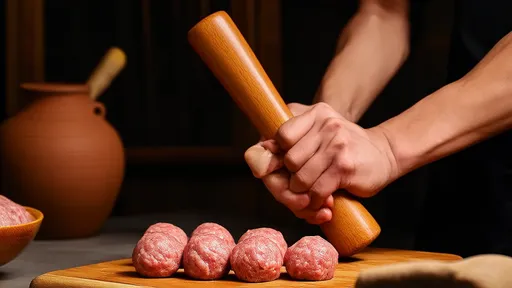
The art of making Chaoshan beef balls is a labor of love and immense physical effort, a tradition passed down through families and skilled artisans. The process begins with the selection of the finest cuts of beef, typically from the hind leg, prized for its lean and sinewy quality. The meat is meticulously trimmed of all fat and fascia, leaving behind pure muscle fiber. This is the foundational canvas upon which the texture is built. It is then placed on a thick, solid tree stump or a large wooden block, and the rhythmic, thunderous pounding begins. Using specially designed heavy metal rods, the chef relentlessly hammers the meat, transforming its structure entirely. This isn’t mere chopping or grinding; it’s a process of physical alchemy.
For decades, the exact duration of this pounding was considered an intuitive skill, a feeling passed from a master’s hands to their apprentice. Some said 30 minutes, others swore by an hour. The lack of standardization meant the quality could vary significantly from one vendor to another. To demystify this culinary secret, a group of food scientists and culinary experts recently undertook a systematic study. They prepared multiple batches of beef paste, each subjected to a different pounding duration under controlled conditions. The key metric for evaluation was elasticity, measured scientifically through texture profile analysis, which quantifies parameters like springiness and chewiness.
The results of the tests were striking and conclusive. Batches pounded for shorter periods, say 20 or 30 minutes, showed improvement over simply ground meat, but they were lackluster. They were softer, more crumbly, and lacked the signature "bounce back" that defines a premium beef ball. The muscle fibers and proteins had not been sufficiently broken down and realigned. As the pounding time increased, the texture dramatically improved. The proteins, primarily myosin and actin, were being physically unraveled and whipped into a sticky, dense paste. This paste acts as a protein gel that can trap tiny air pockets and moisture, the fundamental structure responsible for elasticity.
The pivotal finding was that the magic number emerged at the 40-minute mark. At this precise duration, the beef paste reached its optimal state. The analysis showed a perfect harmony of firmness and springiness. When cooked, these 40-minute beef balls exhibited an unparalleled texture—firm to the touch yet yielding with a satisfying snap, and then bouncing back almost completely. They were juicy, as the pounded protein network excellently retained the meat's natural juices and any added seasonings. This wasn't just a minor improvement; it was the definitive peak of texture perfection.
Why is 40 minutes the sweet spot? The science lies in the complete mechanical denaturation of the meat proteins. The relentless pounding for this specific period thoroughly breaks the cross-links within the muscle fibers without overheating the meat (which would cause protein coagulation and a tough, rubbery texture). It aligns the protein strands into a strong, continuous network. Pounding beyond this point, towards 50 or 60 minutes, led to diminishing returns. The paste began to warm excessively from the friction, and the over-worked protein network started to break down, resulting in a paste that was tougher but paradoxically less springy and more rubbery—a clear sign of over-processing.
This discovery has profound implications for both preserving tradition and guiding modern production. For the street vendors and family-run shops that are the guardians of this craft, it provides a clear, measurable benchmark to ensure consistent, top-tier quality, moving beyond guesswork. It validates the wisdom of the most respected masters. For larger-scale producers who wish to replicate this artisanal quality, it offers a critical parameter for mechanized pounding processes. They can now calibrate their machines to mimic the exact optimal physical action and duration, ensuring every beef ball that comes off their line has the authentic, legendary bounce of the best hand-made versions.
The humble beef ball is more than just a snack; it is a testament to the power of technique and patience in cooking. The conclusion that 40 minutes of relentless pounding is the key to its supreme elasticity is a beautiful intersection of ancient culinary wisdom and modern scientific validation. It underscores that in our rush for efficiency, some traditions cannot be rushed. The perfect bounce, it turns out, is earned with every single strike of the rod, a precise symphony of force and time that transforms simple meat into a textural phenomenon.
By /Aug 20, 2025
By /Aug 20, 2025
By /Aug 20, 2025
By /Aug 20, 2025
By /Aug 20, 2025
By /Aug 20, 2025
By /Aug 20, 2025
By /Aug 20, 2025
By /Aug 20, 2025

By /Aug 20, 2025
By /Aug 20, 2025

By /Aug 20, 2025
By /Aug 20, 2025
By /Aug 20, 2025
By /Aug 20, 2025
By /Aug 20, 2025
By /Aug 20, 2025
By /Aug 20, 2025
By /Aug 20, 2025

By /Aug 20, 2025
