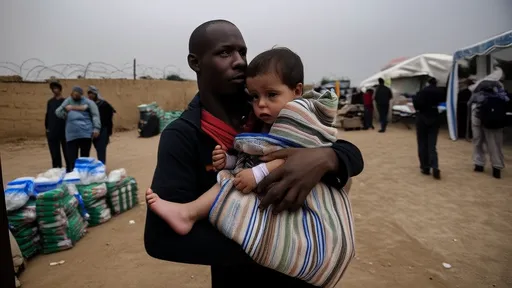
In the cramped corridors of Gaza's remaining hospitals, doctors are facing a medical phenomenon they haven't witnessed on this scale in decades: a rapid and severe surge in child malnutrition. The tiny, listless bodies of infants and young children are becoming a common sight, their sunken eyes and protruding ribs telling a silent story of a deepening humanitarian catastrophe. This is not a gradual decline but a precipitous collapse of nutritional health, directly stemming from what aid agencies are calling a man-made famine, fueled by a crippling blockade that has severed the lifeline of food, clean water, and medicine.
The United Nations, alongside a chorus of international humanitarian organizations, is issuing increasingly desperate pleas. Their central demand is unequivocal: the immediate and unconditional opening of all land crossings into Gaza. They argue that the current trickle of aid, primarily funnelled through a limited number of routes, is woefully inadequate to stave off widespread starvation. The existing mechanisms for aid delivery are described as "a garden hose trying to put out a forest fire," a metaphor that painfully captures the gap between the aid being allowed in and the vast, desperate need on the ground.
The situation inside Gaza is now beyond critical. According to recent assessments from the World Food Programme and UNICEF, the rate of acute malnutrition among children under two in northern Gaza has skyrocketed to levels rarely seen in modern conflicts. These are not just statistics; they represent thousands of individual children whose cognitive and physical development is being permanently scarred, if they survive at all. Parents are resorting to desperate measures, feeding their children animal feed or foraging for wild plants, as the market shelves remain bare and prices for any available food have soared beyond the reach of most families, the vast majority of whom are now internally displaced and without any source of income.
One aid worker, who recently managed to enter Gaza for a brief period, described the scene in a southern Gaza clinic. "The silence is the most haunting part," she said, requesting anonymity due to security concerns. "A ward full of young children should be filled with noise—crying, babbling, laughter. But here, the children are too weak to cry. They just lie there, their breathing shallow, their energy completely depleted. The mothers have a look of hollowed-out despair, knowing there is little they can do." This firsthand account underscores the human reality behind the alarming data points.
The logistical challenges are monumental. Even when aid trucks are cleared to enter, the process is slow, bureaucratic, and fraught with delays. Once inside, the distribution is hampered by a lack of security, damaged infrastructure, and communications blackouts. Many trucks are simply overwhelmed by crowds of desperate people before they can reach their intended distribution points. Furthermore, the aid that does get through often lacks the specific therapeutic foods and micronutrient supplements essential for treating severely malnourished children. You cannot reverse starvation with sacks of flour alone; it requires a specialized, sustained, and scaled-up nutritional response.
At the heart of this crisis is the issue of access. The UN and major aid groups have been clear that air drops and a proposed maritime corridor, while symbolically significant, are no substitute for the massive capacity of land routes. A single truck crossing via land can carry the equivalent of multiple air-dropped pallets, at a fraction of the cost and with far greater efficiency. The international community is pressing for the reopening of key crossings like Kerem Shalom and the Erez crossing, which have been closed or operating at a severely reduced capacity for months. These crossings are the arteries through which life-saving assistance must flow, and currently, they are constricted to a dangerous degree.
The political dimensions of the conflict are complex and deeply entrenched, but humanitarian leaders are drawing a clear red line. "The politics of this war cannot be allowed to starve children," stated a high-level UN official in a recent, unusually blunt press conference. "There is a fundamental principle of international humanitarian law that is being violated: the obligation to allow and facilitate rapid and unimpeded passage of humanitarian relief for civilians in need. The starvation of a civilian population as a method of warfare is prohibited and constitutes a war crime." This strong language reflects the growing frustration and alarm within the international aid community.
Meanwhile, on the ground, Palestinian health workers are performing miracles with dwindling resources. With medical supplies critically low, including essential vitamins and rehydration salts, they are improvising treatments and working in shifts to monitor the most vulnerable children around the clock. Their resilience is staggering, but they are the first to admit they are fighting a losing battle without a massive and immediate influx of support. "We are doctors, not magicians," one exhausted pediatrician in Khan Younis remarked. "We can diagnose the malnutrition, we can see the stunting and the wasting, but without the right food and medicine, our hands are tied. We are watching a generation fade away before our eyes."
The clock is ticking for thousands of children in Gaza. The window to prevent a massive loss of life from hunger and disease is closing rapidly. The calls from the United Nations are not merely procedural requests; they are a final alarm bell for the international community. Opening all border crossings to a sustained and massive flow of humanitarian aid is not a political solution to the broader conflict, but it is the most immediate and tangible step to prevent a historic tragedy. The world is watching, and the question remains whether the political will can be mustered to turn the keys and open the gates before it is too late for the children of Gaza.

By /Oct 14, 2025
By /Oct 13, 2025

By /Oct 13, 2025

By /Oct 14, 2025

By /Oct 13, 2025

By Amanda Phillips/Oct 13, 2025

By /Oct 14, 2025

By /Oct 13, 2025

By /Oct 14, 2025

By Laura Wilson/Oct 13, 2025

By David Anderson/Oct 13, 2025

By Grace Cox/Oct 13, 2025

By /Oct 14, 2025

By /Oct 14, 2025

By /Oct 14, 2025
By /Oct 13, 2025
By /Oct 13, 2025

By /Oct 14, 2025
By /Oct 14, 2025

By /Oct 14, 2025
