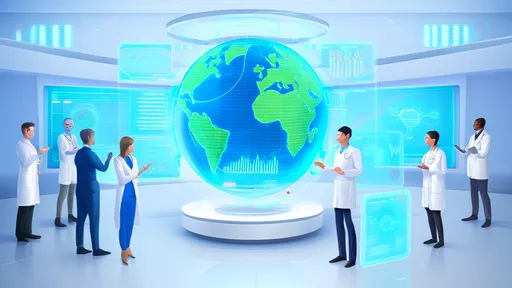
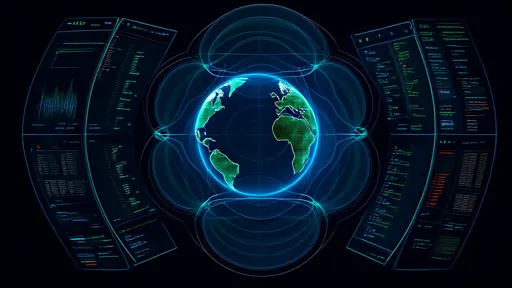
In a groundbreaking fusion of artificial intelligence and planetary science, researchers have unveiled a revolutionary approach to monitoring Earth's health through the lens of large language models. This ambitious project, spanning multiple international research institutions, has developed a comprehensive framework that analyzes 48,000 distinct variables to construct what scientists are calling the most complete portrait of planetary wellbeing ever attempted.
The initiative represents a paradigm shift in how we understand and measure global ecological stability. Rather than focusing on isolated environmental indicators, the system employs sophisticated AI algorithms to detect subtle patterns and interconnections across atmospheric, oceanic, terrestrial, and biological systems. What emerges is not merely a collection of data points but a living, breathing diagnosis of our planet's condition, complete with early warning systems for potential environmental crises.
At the heart of this endeavor lies the unprecedented computational power of modern large language models, which have been retrained to understand the complex language of Earth systems. These models process information ranging from satellite imagery and ocean temperature readings to wildlife migration patterns and atmospheric chemistry, identifying relationships that have previously eluded human researchers. The system continuously updates its assessment, creating what amounts to a real-time vital signs monitor for the entire planet.
The selection of 48,000 variables was neither arbitrary nor exhaustive but represented the culmination of decades of environmental research. Scientists identified key indicators across eight primary domains: atmospheric composition, climate patterns, ocean health, biodiversity, land use, freshwater systems, polar regions, and human impact factors. Each domain contains thousands of interconnected measurements that together paint a multidimensional picture of planetary health.
What makes this approach particularly powerful is its ability to detect emergent properties – complex behaviors and conditions that arise from the interaction of simpler components. Traditional monitoring systems might track deforestation rates in the Amazon or coral bleaching in the Great Barrier Reef as separate phenomena. This new framework can identify how these events influence global weather patterns, carbon cycles, and even socioeconomic stability in distant regions.
The development team faced significant challenges in creating a unified language to describe planetary health. Earth systems operate across vastly different timescales and spatial dimensions, from the rapid mutation of viruses to the slow drift of continental plates. The solution emerged through what researchers call "temporal scaffolding" – a method that allows the AI to understand relationships between processes that unfold over seconds and those that span millennia.
Early applications of the system have already yielded surprising insights. The model identified previously unrecognized feedback loops between urban heat islands in rapidly developing Asian cities and precipitation patterns in North American agricultural regions. It also detected subtle shifts in deep ocean currents that appear to be influencing the frequency of extreme weather events with greater accuracy than conventional climate models.
Perhaps most remarkably, the system has demonstrated an uncanny ability to predict environmental tipping points – those critical thresholds beyond which ecosystems may undergo rapid and often irreversible change. By analyzing the complex interplay between the 48,000 variables, the AI can identify when multiple systems are approaching their limits simultaneously, providing policymakers with crucial advance warning.
The ethical dimensions of such comprehensive planetary monitoring have sparked intense discussion within the scientific community. Some researchers express concerns about the potential for such systems to be used for geopolitical advantage or to justify controversial interventions in natural systems. The development consortium has established strict governance protocols, including international oversight committees and transparent reporting requirements.
Implementation challenges remain substantial. Many of the 48,000 variables require specialized monitoring equipment deployed across the globe, from deep-sea sensors to high-altitude atmospheric samplers. Maintaining this vast observational network demands unprecedented international cooperation and significant financial investment. However, proponents argue that the cost pales in comparison to the potential economic impact of unanticipated environmental catastrophes.
Looking forward, researchers envision the system evolving into a planetary early warning network that could help humanity navigate the complex environmental challenges of the coming century. The ultimate goal is not merely to document Earth's decline but to identify pathways toward recovery and resilience. The system's architects hope it will empower smarter policy decisions, more targeted conservation efforts, and more effective international environmental agreements.
As climate change accelerates and biodiversity loss continues at alarming rates, the need for comprehensive planetary health monitoring has never been more urgent. This AI-driven approach represents a quantum leap in our ability to understand the complex system we call home. While the technology continues to mature, its initial successes suggest we may be entering a new era of environmental awareness – one where we can finally see the forest, the trees, and every intricate connection between them.
The project stands as a testament to human ingenuity and our growing capacity to address global challenges through technological innovation. By harnessing the pattern-recognition capabilities of large language models and applying them to the ultimate complex system, researchers have created what may become an indispensable tool for planetary stewardship in the Anthropocene epoch.
By /Oct 14, 2025

By /Oct 13, 2025
By /Oct 13, 2025

By /Oct 14, 2025

By /Oct 13, 2025

By Amanda Phillips/Oct 13, 2025

By /Oct 14, 2025

By /Oct 13, 2025

By /Oct 14, 2025

By Laura Wilson/Oct 13, 2025

By David Anderson/Oct 13, 2025
By Grace Cox/Oct 13, 2025

By /Oct 14, 2025

By /Oct 14, 2025

By /Oct 14, 2025
By /Oct 13, 2025
By /Oct 13, 2025

By /Oct 14, 2025
By /Oct 14, 2025

By /Oct 14, 2025
